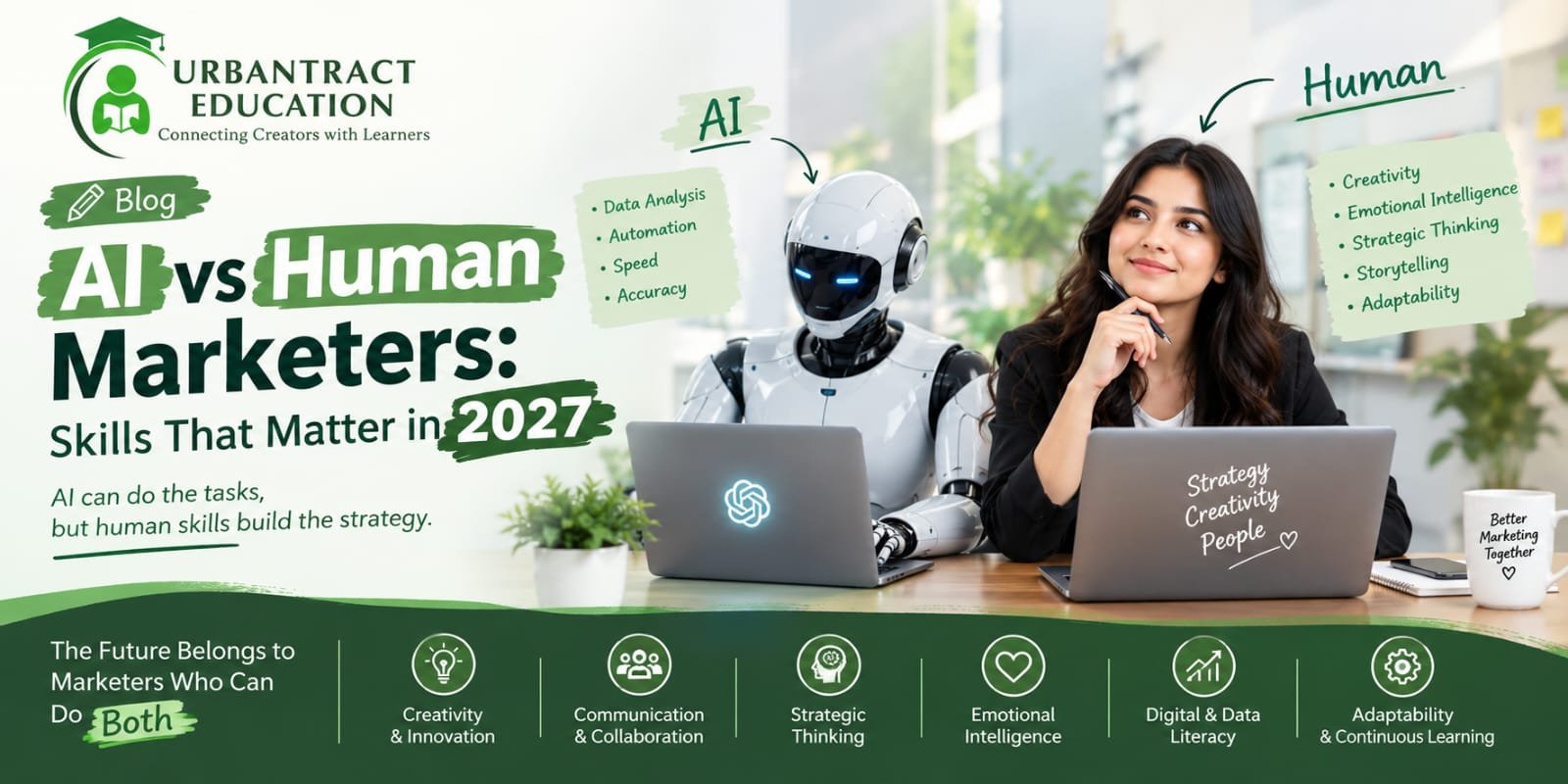
AI vs Human Marketers will continue to shape digital marketing in 2027. AI has changed many areas of marketing. For example, marketers use AI for content creation, customer analysis, advertising, and marketing strategies.
Thank you for reading this post, don't forget to subscribe!As AI becomes more common, many marketers wonder if it will replace human professionals. However, AI is unlikely to replace human marketers completely. Instead, businesses can use AI tools with human skills and judgment.
AI can handle repetitive tasks, analyze data, and generate ideas quickly. However, human marketers bring creativity, empathy, communication, and strategic thinking.
Therefore, the most valuable marketers in 2027 may be those who understand how to combine AI tools with human skills.
The Growing Role of AI vs Human Marketers in Digital Marketing
AI is already influencing the work of digital marketers. For example, marketers use AI to brainstorm ideas, write draft content, analyze data, create images, automate tasks, and personalize customer journeys.
AI can also analyze campaign performance and identify patterns quickly. As a result, marketers can save time on repetitive tasks and focus on more complex activities.
However, getting an outcome is not the same as understanding a brand and its audience. Human marketers still need to provide context, creativity, and judgment.
Brainstorm Ideas
Write Draft Content
Analyze Data
Create Images
Automate Tasks
Create Personalized Customer Journeys
AI and Human Marketers: Working Together in 2027
The future of digital marketing is not simply about AI versus humans. Instead, it is about how marketers use AI effectively.
AI can support speed, automation, pattern recognition, data analysis, and content variations. On the other hand, people bring empathy, cultural understanding, context, creativity, and complex decision-making.
For example, a company launching a new product can use AI for competitor research, keyword suggestions, content ideas, and an early marketing strategy. However, a human marketer should review the strategy and check whether it fits the brand and its audience.
Therefore, marketers who understand both AI tools and human-centered skills can adapt to changing marketing needs.
AI Literacy Will Become Essential
Digital marketers do not need to become AI engineers. However, they should understand how AI tools work and how to use them effectively. AI literacy can include writing useful prompts, checking AI-generated content, automating repetitive tasks, and choosing suitable AI tools. In addition, marketers should review AI outputs instead of depending on them completely. This skill can help marketers improve productivity while maintaining quality and accuracy.
Creativity Will Matter More, Not Less
AI can generate thousands of ideas quickly. However, quantity does not always mean quality. Human creativity remains important in marketing. Original ideas, emotional appeal, storytelling, and audience understanding can make a campaign more effective. For example, AI may generate several campaign ideas. A human marketer can then review those ideas and select the most suitable one.
Therefore, creativity in 2027 will involve more than creating ideas. Marketers will also need to refine, select, shape, and communicate strong concepts.
Strategic Thinking Will Be a Major Advantage
Strategic thinking will remain an important marketing skill. Using an AI tool is useful. However, marketers also need to know why, when, and where to use it. A good strategist understands the customer, business goals, competitors, positioning, customer journey, and marketing funnel.
In addition, marketers should evaluate AI recommendations before using them. They need to check whether the recommendation fits the business and its audience.
Data Analysis and Interpretation
Digital marketing provides marketers with large amounts of data. This data can include website traffic, user engagement, conversions, shopping behavior, ad performance, and search queries. AI tools can process much of this information quickly. However, marketers still need to understand what the data means.
For example, an ad may receive 10,000 clicks but generate only one sale. Looking at clicks alone does not explain the problem.
Therefore, marketers need data interpretation skills. They should understand why users clicked, why they did not purchase, and what the business can improve.
Understanding the Audience
Marketing has always focused on people. Therefore, marketers need to understand customer needs, pain points, motivations, and buying decisions. AI can identify patterns in customer data. However, human marketers can add empathy and real-world context.
As a result, understanding the audience can help marketers create campaigns that feel relevant and meaningful.
Storytelling and Communication
Even with advanced AI, people still connect with stories. For example, brands use stories in YouTube videos, blogs, advertisements, social media posts, and other content. Strong communication helps marketers explain ideas clearly. Moreover, good storytelling can make content easier to understand and remember.
AI can assist with writing. However, human marketers still need to decide the tone, direction, message, and purpose of the content.
SEO Will Evolve
SEO will continue to change as search behavior and AI-powered search develop. In the future, marketers will need to focus on more than keywords. For example, search intent, useful answers, topical authority, user experience, and original content will remain important.
Therefore, SEO professinoals will need to understand both traditional search practices and AI-driven changes in search behavior.
Adaptability Will Be One of the Most Valuable Skills
Digital marketing changes quickly. New algorithms, platforms, AI tools, ad formats, and consumer trends can appear at any time. Therefore, marketers need to stay adaptable. They should learn new technologies, test different approaches, track results, and make changes when needed.
Learning one tool is not enough. Instead, marketers should develop the ability to learn and adapt continuously.
Human Skills AI Cannot Replace Easily
As AI becomes more powerful, certain human skills may become even more valuable.
These include:
- Critical thinking
- Emotional intelligence
- Creativity
- Leadership
- Communication
- Empathy
- Negotiation
- Decision-making
- Brand understanding
- Relationship building
Moreover, these skills help marketers work effectively with clients, teams, creators, customers, and businesses.
Technology can support marketing tasks. However, people still build relationships with other people.
Will AI Replace Human Marketers?
AI may automate some marketing tasks, especially repetitive activities. However, this does not mean that AI will replace all human marketers. Instead, the role of marketers may change. AI can handle repetitive work and give marketers more time for strategy, creativity, and decision-making.
For example, marketers who use AI tools effectively can spend less time on manual tasks. They can then focus more on campaign planning and customer needs.
Therefore, the future may focus less on humans versus AI and more on how humans use AI effectively.
Conclusion
Digital marketing will continue to change as AI becomes more integrated into marketing activities. AI can support content creation, SEO, advertising, analytics, personalization, and automation.
However, technology alone cannot create every successful marketing strategy. Human skills such as creativity, strategic thinking, emotional intelligence, storytelling, communication, and audience understanding will remain important.
In conclusion, marketers in 2027 will need to learn how to work effectively with AI. The key question will not simply be whether AI can complete a task. Instead, marketers should consider how they can use AI to improve their work and create better experiences for their audiences.