Thank you for reading this post, don't forget to subscribe!
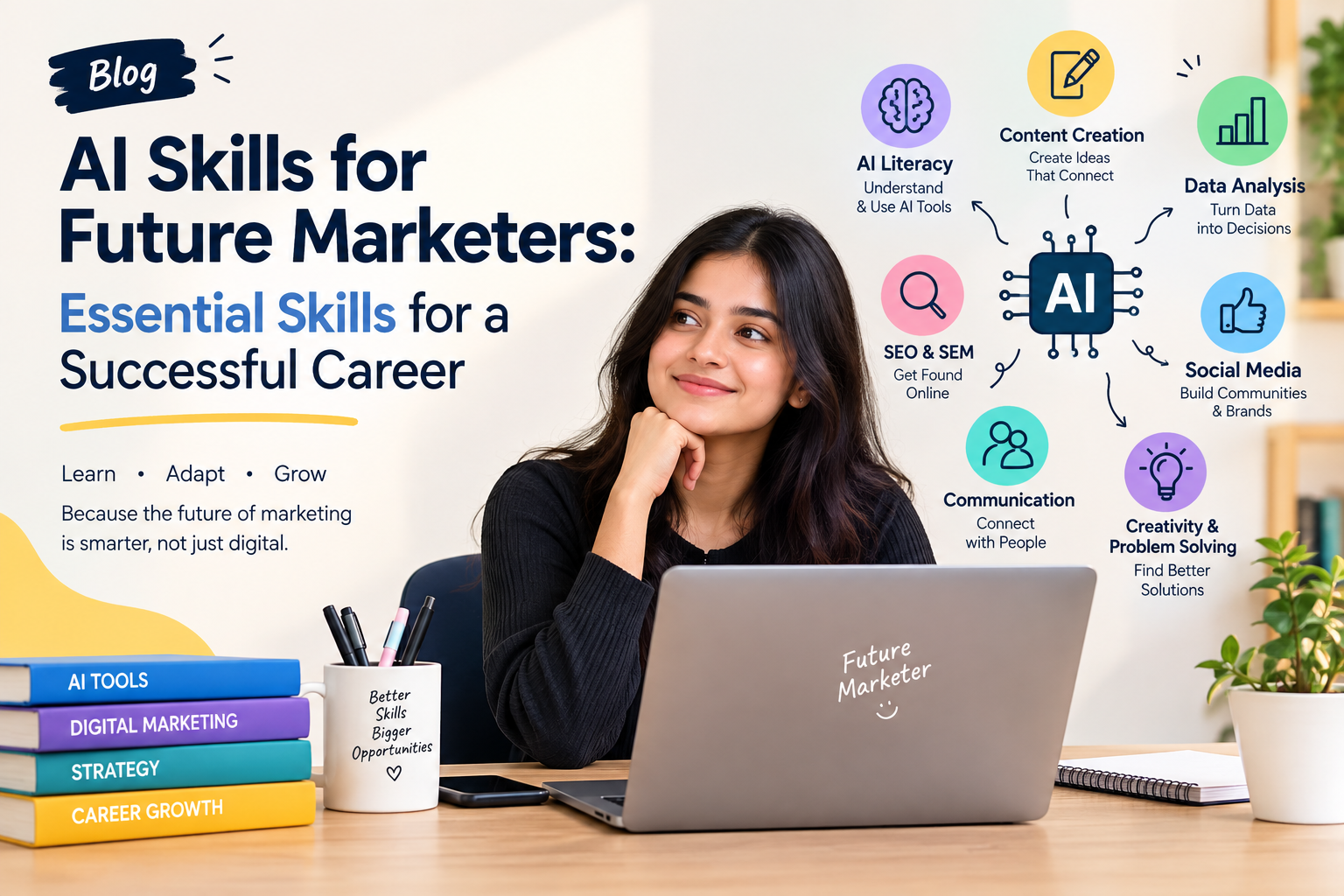
Artificial intelligence is changing the way marketers look at audiences, make content, check data, manage campaigns, and talk to customers. This does not mean that AI is taking over digital marketing jobs. Instead the job of a marketer is changing.
You can understanding how to use AI tools can help marketers get but understanding when, why and how to use AI well is becoming even more important.
For students and people who want to work in marketing this creates a big question: What AI skills should you really learn to have a good marketing career?
The answer is not learn “ChatGPT.” need a mix of AI understanding, marketing knowledge, data skills, imagination, planning and real-life thinking.
Why AI Skills Matter for Digital Marketers
Traditional digital marketing already includes repetitive tasks like keyword research coming up with content ideas creating reports analyzing audiences drafting emails and watching campaigns.
AI can make a lot of these tasks faster.
AI to come up with content ideas in a few minutes dig through big sets of campaign data write different versions of ad copy or spot trends in how customers behave.
Even when AI creates something it still needs a person to check it.
An AI tool might produce ten content ideas. Only a marketer can pick which one fits the audience matches what people are searching for stays true to the brand’s voice and supports business goals.
That’s why the future isn’t, about people who just use AI tools. It’s about marketers who know how to mix AI with marketing strategy.
Want to build practical digital marketing and AI skills? Explore learning opportunities with UrbanTract Education and develop skills that can be applied to real marketing activities.
-
AI Literacy: Understand How AI Actually Works
One of the things marketing professionals should learn about artificial intelligence is how it really functions and where it can be helpful.
You don’t have to turn into a machine learning expert or know all the information. What matters is having a basic idea of concepts such as:
- Generative AI
- Large Language Models (LLMs)
- Machine learning
- AI automation
- Natural Language Processing
- AI-powered analytics
- AI limitations and hallucinations
These concepts help marketers choose the right tool for the right task.
You’ll understand that AI is capable of creating content without the need for human input, but it’s less likely to publish AI-generated content without checking facts.The goal is not to become an AI developer. The goal is to become an AI-aware marketer.
Literacy in AI is useful because marketers may work with several different tools during their careers. Instead of learning every tool individually, understanding the key concepts helps them understand what a tool is designed to do.
For instance, generative AI can help with creating content, while AI-powered analytics can help identify patterns in data. Automation can help connect repetitive tasks and reduce manual work.
A future marketer should also understand that AI output depends on the information, instructions and context provided to it. This is why human review remains important.
-
Prompt Engineering for Marketing
One of the most valuable AI skills for marketers is prompt writing. A vague prompt often produces a generic answer.
For example:
Weak prompt:
“Write a blog about SEO.”
A better marketing prompt would provide the target audience, search intent, keyword, tone, structure, word count, and objective.
This allows the marketer to guide the AI instead of simply accepting whatever it produces.
Future marketers should learn how to create prompts for:
- Blog research
- Content briefs
- Social media posts
- Ad copy
- Email campaigns
- SEO ideas
- Customer personas
- Competitor analysis
- Content repurposing
Still, good prompting alone is not enough. Marketing knowledge determines whether the AI output is actually useful.
-
AI-Powered SEO
SEO is becoming increasingly connected with AI.
Marketers can use AI to support activities such as:
- Keyword research
- Search-intent analysis
- Content outlines
- Topic clustering
- Internal linking ideas
- Meta title and description suggestions
- Content optimization
- Competitor research
But SEO should not become “publish whatever AI writes.”
“I notice that” search engines and users still need relevant trustworthy content. The future SEO professional should therefore understand both SEO principles and AI-assisted workflows.
For instance, AI can suggest keywords related to ” marketing course ” however the marketer still needs to understand what the user is actually looking for a course, career information, fees or course comparisons.
AI helps make SEO research quicker. Ai does not remove the need, for keyword intent and target audience understanding. Marketer should still look at what users trying to find and whether a page actually answers that need.
AI also helps marketers discover topics and organize content ideas. AI can be useful when building a content strategy around a topic.
The important skill is knowing how to use AI without losing the fundamentals of SEO.
-
AI Content Strategy
AI is transforming content creation faster—but faster content does not automatically mean better content.
This is where content strategy becomes important.
Future marketers should know how to use AI to move from:
Idea → Research → Content Brief → Creation → Editing → Optimization → Distribution → Analysis
AI may help with steps but the marketer must control the overall strategy. For example of asking AI to create 20 random Instagram posts the marketer can build a monthly content strategy based on the following:
- Audience problems
- Business goals
- Content pillars
- Search trends
- Customer questions
- Product/service offerings
- Performance data
This makes AI a strategic assistant rather than a content replacement.
-
AI and Data Analytics
Future marketers will need to be comfortable working with data from tools such, as Google Analytics and Google Search Console. Future marketers will also need to use advertising platforms, social media insights and CRM systems.
AI can help marketers:
- Identify patterns
- Summarize reports
- Find unusual changes
- Compare campaign performance
- Segment audiences
But is an important difference between reading a report and understanding marketing data.
Marketers truly understand the meaning of metrics such, as CTR, conversion rate, CPC, CPA, bounce rate, engagement rate and ROAS.
AI helps explain CTR, conversion rate, CPC, CPA, bounce rate, engagement rate and ROAS data yet marketers must decide what action should be taken based on those insights.
-
AI Automation Skills
Automation will also be an important skill for future marketers.
Rather than spending time on repetitive tasks, digital marketing and AI can help marketers connect different tools and automate parts of their workflows.
For example:
New lead → CRM → Email → Follow-up reminder → Sales notification
AI and automation can also support:
- Email personalization
- Lead qualification
- Customer follow-ups
- Reporting
- Social media workflows
- Content distribution
- Data organization
Learning platforms and concepts related to automation can help marketers save time and focus more on strategy and creative work.
-
AI for Paid Advertising
AI is already becoming part of modern advertising platforms.
Marketers can use AI to support:
- Ad copy variations
- Audience research
- Creative ideas
- Campaign analysis
- Keyword suggestions
- Performance optimization
- Personalization
While AI can assist with paid advertising a marketer still needs to understand the fundamentals of paid advertising.
You should know concepts such as:
- CPC
- CPM
- CTR
- Conversion rate
- CPA
- ROAS
- Target audience
- Campaign objectives
The strongest combination is therefore:
Advertising knowledge + AI tools + data analysis
-
Customer and Audience Understanding
AI can analyze huge amounts of customer information, but understanding people still requires human thinking.
Future marketers should learn how to develop:
- Customer journeys
- Pain points
- Audience segments
- Search intent
- Customer motivations
Even when two people search for the same product but have completely different reasons for doing so. AI can identify useful patterns, however marketers need to translate those patterns into better messaging and customer experiences.
-
AI Ethics and Fact-Checking
AI is becoming more common, in marketing and ethical skills of intelligence will become increasingly important. Artificial intelligence can produce misleading information.
Therefore, marketers should develop habits such as:
- Fact-checking AI-generated information
- Protecting customer data
- Avoiding misleading content
- Reviewing AI-generated claims
- Checking copyright considerations
A marketer should never assume that an AI-generated answer is automatically correct. Human review is still essential.
-
Creativity and Human Skills
This may appear surprising. As AI improves at creating content human creativity becomes even more valuable.
Future marketers should strengthen skills such, as:
- Creative thinking
- Communication
- Storytelling
- Problem-solving
- Decision-making
- Brand thinking
- Emotional understanding
- Critical thinking
AI can generate hundreds of headlines. But understanding which headline will connect with a specific audience and why is a marketing skill. That human judgment can make the difference between average AI-assisted marketing and effective marketing.
What Should Students Learn First?
Students don’t need to learn every AI tool available. A better approach is to build skills in the right order.
Start with marketing fundamentals
Learn:
SEO → Content Marketing → Social Media Marketing → Google Ads → Email Marketing → Analytics
Then add:
AI Tools → Prompt Engineering → AI-powered SEO → Automation → AI Analytics
Finally, develop:
Strategy → Creativity → Critical Thinking → Data-driven Decision Making
This creates a much stronger profile than simply listing dozens of AI tools on a resume.
AI Skills vs Traditional Marketing Skills
| Traditional Marketing Skill | AI-Enhanced Skill |
| Keyword research | AI-assisted keyword and intent analysis |
| Content writing | AI-driven content creation and editing |
| Audience research | AI-powered audience insights |
| Campaign analysis | AI-assisted performance analysis |
| Email marketing | AI personalization and automation |
| SEO | AI-supported SEO workflows |
| Advertising | AI-assisted campaign optimization |
| Reporting | Automated reporting and insights |
The main point is that AI does not take away the need for marketing fundamentals. AI actually strengthens marketing fundamentals.
This difference matters a lot for students who are getting ready, for marketing career. Of seeing AI as its own skill students can discover how AI fits into the marketing fundamentals they already have.
How can students learn AI and digital marketing without work experience
You don’t necessarily need a full-time marketing job to start building a portfolio.
Students and freshers can create practical projects such as:
- An SEO content plan for a fictional business
- A keyword research project
- A social media content calendar
- A Google Ads campaign structure
- An AI-assisted blog workflow
- A customer persona
- An email marketing sequence
- A simple marketing dashboard
Document what you did, which tools you used, why you made each decision, and what you learned. This gives recruiters something more valuable than simply seeing “AI Tools” listed under skills on a resume.
A portfolio can show how a student thinks and applies knowledge. For example, instead of only mentioning keyword research as a skill, a student can show a sample keyword research project and explain how the keywords were selected.
Similarly, an AI-assisted content project can show the original objective, research process, prompt approach, editing process and final result.
Why Practical AI Marketing Skills Matter
Learning concepts is important. However, practical application makes those concepts easier to understand. When you practice the learning becomes real.
A student who experiments with SEO, content strategy, analytics, advertising and AI tools can start understanding how marketing decisions are actually made. By testing each part the student sees how marketing works in life.
For example, a student can choose a business and create a complete marketing workflow. The student can research the audience identify keywords prepare content ideas design a media plan create a basic advertising structure and analyze sample performance data. The purpose is not to create a perfect campaign. The purpose is to understand the reasoning behind each marketing activity.
This approach can also help students become more confident when discussing AI and digital marketing during interviews.
Conclusion
AI is changing digital marketing, but the future is unlikely to belong to marketers who simply know the largest number of AI tools. These who can think strategically, understand customers, work with data, use AI efficiently, and make good decisions.
Students planning a career in digital marketing, the best approach is not to choose between marketing and AI. Learn marketing first. Now use AI to make your marketing skills more powerful.
You start a developing these skills now, you can build a career profile that is better prepared for the changing digital marketing industry.
Ready to develop practical digital marketing and AI skills? Explore Digital Marketing & AI learning opportunities with UrbanTract Education and build skills in SEO, social media marketing, content marketing, Google Ads, analytics, and AI-powered marketing.