
Thank you for reading this post, don't forget to subscribe!
Starting a career in digital marketing can be exciting, but it can also be challenging for freshers. The biggest challenge is often the lack of professional experience.
Many companies want to see what you can actually do. They may ask about your previous projects, campaigns, or practical experience. This can make beginners wonder, “How can I create a digital marketing portfolio if I have never worked for a company?”
The good news is that you don’t need years of experience to build a strong portfolio. Personal projects, course assignments, internships, and sample campaigns can help you showcase your skills.
A well-designed digital marketing portfolio can demonstrate your knowledge of SEO, content marketing, social media marketing, Google Ads, analytics, and other essential digital marketing skills.
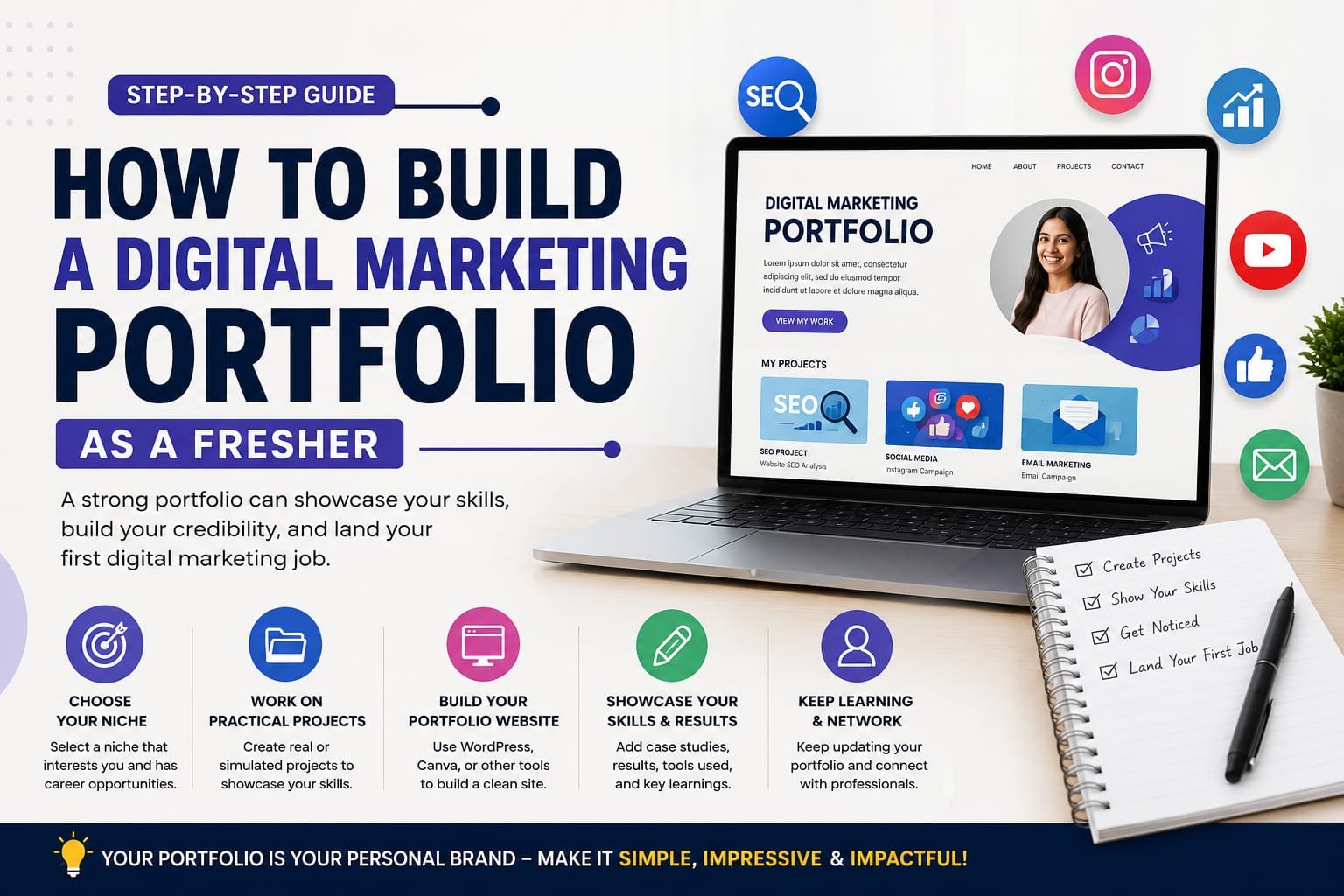
In this guide, you’ll learn how to build a digital marketing portfolio as a fresher, which projects to include, how to create case studies, and how to present your work to potential employers.
What Is a Digital Marketing Portfolio?
A digital marketing portfolio is like a folder that holds all the things you have actually done. It shows people what you are good at when it comes to marketing.
Think of it like this: it is proof that you can really do the things you say you can do.
For example your resume might say that you are skilled in things like SEO and content marketing and social media marketing.
It can include:
- A keyword research project
- An SEO audit
- A blog optimized for search engines
- A social media content calendar
- A sample Google Ads campaign
- A competitor analysis
- A website optimization project
- A marketing strategy
- Analytics reports
This makes it easier for people who are hiring to see what you can really do. It makes your digital marketing skills more real, to them. A digital marketing portfolio is a way to show people what you are capable of.
For people who’re new to the field a portfolio is really important because it can make up for not having a lot of work experience.
Why Do Freshers Need a Digital Marketing Portfolio?
Digital marketing is a field that’s all about doing things in the real world. The people who hire do not just want someone who knows what the words mean they want someone who can actually use the marketing ideas in life situations.
- A portfolio can help you do a lot of things such as:
- Demonstrate that you have skills that you can actually use
- Be different from people who are new to the field
- Show that you are a person
- Talk about what you learned and how you learned it
- Feel more confident when you are talking to someone, about a job
- Give the people who are hiring you something to look at so they can see what you can do
- Demonstrate that you know how to use the tools that are used in marketing
Get a chance to work as an intern or do freelance work, which is digital marketing work that you do on your own.
Want to start a career in marketing but not sure how?
A hands-on Digital Marketing Course can help you gain knowledge, about SEO, social media marketing, content marketing, Google Ads, analytics and other important skills by working on projects.
Build skills. Create projects. Develop your portfolio. Get career-ready.
Start learning Digital Marketing with UrbanTract Education today and take your first step toward building a successful digital marketing career.
What should a digital marketing portfolio include?
A good portfolio does not need to have dozens of projects. 4 to 6 well-presented projects can make a strong impression if they show different skills.
Your portfolio can include:
- About Me
- Digital Marketing Skills
- SEO Projects
- Content Marketing Projects
- Social Media Projects
- Google Ads PPC Projects
- Analytics Projects
- Certifications
- Case Studies
- Contact Information
“Let’s look at each section.”
1. Start With a Professional “About Me” Section
Your portfolio should begin with a short introduction.
You don’t need to write your entire life story.
Explain:
- Who you are
- Your educational background
- Your digital marketing training
- Your key skills
- Your career goal
Keep your introduction professional and focused on your career.
2. Highlight Your Digital Marketing Skills
Create a dedicated skills section.
You can divide your skills into different categories.
SEO
- Keyword Research
- On-Page SEO
- Off-Page SEO
- Technical SEO Basics
- Internal Linking
- SEO Audits
- Meta Optimization
- Search Intent
Content Marketing
- Blog Writing
- Content Strategy
- Content Calendars
- Copywriting
- Website Content
- Content Optimization
Social Media Marketing
- Instagram Marketing
- Facebook Marketing
- LinkedIn Marketing
- Social Media Strategy
- Content Planning
- Audience Research
Paid Marketing
- Google Ads Basics
- Keyword Targeting
- Ad Copy
- Campaign Structure
- CPC
- CTR
- Conversion Tracking
Analytics
- Google Analytics
- Google Search Console
- Website Traffic Analysis
- Campaign Reporting
- Performance Analysis
Only include skills you understand well enough to discuss during an interview.
3. Create an SEO Portfolio Project
SEO is one of the best areas for a fresher to demonstrate practical skills.
You can create an SEO project using your own website, a sample website, or a hypothetical business.
Your project can include
Project Title: SEO Audit & Optimization Strategy for a Small Business Website
Step 1: Website Analysis
Analyze:
- Website structure
- Page titles
- Meta descriptions
- Headings
- URLs
- Images
- Internal links
- Content quality
Step 2: Keyword Research
Identify relevant keywords based on:
- Search intent
- Relevance
- Competition
- Business goals
Step 3: Recommendations
Explain what you would improve.
For example:
- Optimize title tags
- Improve meta descriptions
- Add relevant H2 headings
- Improve internal linking
- Optimize images
- Create supporting blog content
This becomes a practical SEO case study.
4. Build a Content Marketing Project
Content marketing is another excellent category.
Choose a business or website and create a small content strategy.
Then explain your strategy.
Example Content Pillars
Educational Content
Tips, guides, and how-to articles.
Product Content
Product features, benefits, and use cases.
Engagement Content
Polls, questions, quizzes, and interactive posts.
Promotional Content
Offers, launches, and special campaigns.
This demonstrates that you understand how content supports business goals.
5. Create a Social Media Marketing Project
You can create a sample social media campaign for a fictional or real business.
Your project can include:
- Target audience
- Platform selection
- Content pillars
- Content calendar
- Caption examples
- Hashtag strategy
- Creative concepts
- Engagement strategy
- KPIs
Content Types
- Reels
- Carousels
- Product posts
- Customer testimonials
- Behind-the-scenes content
- Educational posts
You can present the campaign in a visually attractive format using Canva or a similar design tool.
6. Create a Google Ads/PPC Project
If you want to apply for PPC or performance marketing jobs, include a Google Ads project.
You don’t necessarily need to spend your own money on advertising to demonstrate your understanding.
You can create a sample campaign plan.
Include:
- Campaign objective
- Target audience
- Keyword research
- Match types
- Ad groups
- Sample ad copy
- Landing page recommendation
- Conversion goal
- KPIs
You can create sample search ads and explain why you selected the keywords and messaging.
Clearly label the project as a sample or practice campaign if it was not actually run.
7. Add a Google Analytics or Data Analysis Project
Employers appreciate candidates who understand data.
Create a sample analytics report or use data from a project you are legitimately allowed to analyze.
Your report could include:
- Traffic sources
- User engagement
- Top-performing pages
- Conversion data
- Search performance
- Recommendations
You can present the information through simple charts or tables.
The most important part is not just showing numbers.
8. Create Digital Marketing Case Studies
Case studies can make your portfolio much stronger.
A good case study should answer four questions:
What was the problem?
For example:
“A website had low organic visibility and limited content.”
What did you analyze?
Explain your research and findings.
What strategy did you recommend?
Describe the SEO, content, social media, or advertising strategy.
What were the results?
If you actually implemented the project, include genuine results.
If it was only a practice project, don’t invent results.
Instead write,
The thing I am hoping for is that the keywords are targeted in a way the content is structured nicely and we get more chances to be seen by people who are searching for things online.
Never make up numbers, about how many people are visiting a website or how high it is ranked or how many sales it is making, just to make a portfolio look good.
Build your digital marketing skills with UrbanTract Education. Learn, practice, build your portfolio, and start your career today!
9. Add Certifications
Certifications can support your portfolio, especially when you’re a fresher.
You can include relevant certifications in areas such as
- SEO
- Google Ads
- Analytics
- Content marketing
- Social media marketing
- Email marketing
- Digital marketing fundamentals
For each certification, mention
- Certification name
- Issuing organization
- Completion date
However, remember that certificates demonstrate learning, while projects demonstrate application.
Try to combine both.
10. Add the Tools You Know
Create a tools section in your portfolio.
Depending on your experience, you might include
- Google Analytics
- Google Search Console
- Google Ads
- WordPress
- Canva
- Microsoft Excel
- Google Sheets
- SEO tools
- Social media analytics tools
- AI-assisted marketing tools
Don’t list a tool just because you have heard of it.
Be ready to explain how you used it.
11. Build Your Portfolio Website
One of the best ways to present your work is through a simple portfolio website.
You can create one using
- WordPress
- Website builders
- Google Sites
Your website can have pages such as:
Home
Short introduction and career objective.
About
Your education, training, and background.
Skills
Your digital marketing skills.
Projects
Your practical projects and case studies.
Certifications
Your completed certifications.
Contact
Email or professional contact information.
Keep the design clean and easy to navigate.
12. Create a Portfolio for the Job You Want
Your portfolio should match your career goal.
If you want an SEO job, focus more on
- Keyword research
- SEO audits
- On-page optimization
- Content strategy
- Search Console
- Technical SEO basics
Social media job, focus on
- Content calendars
- Social media strategies
- Campaign ideas
- Captions
- Creative concepts
- Analytics
PPC job, focus on
- Keyword research
- Campaign structures
- Ad copy
- Audience targeting
- KPIs
- Conversion tracking
Don’t make your portfolio unnecessarily large.
Make it relevant.
13. How Many Projects Should a Fresher Have?
You don’t need 20 projects.
A strong beginner portfolio can start with 4–6 quality projects.
For example:
- SEO audit project
- Keyword research project
- Content marketing strategy
- Social media campaign
- Google Ads sample campaign
Each project should explain your role, process, tools, and outcome or recommendations.
Quality is more important than quantity.
14. How to Present Your Portfolio in a Job Interview
Don’t just send the portfolio link. Hope the recruiter figures everything out.
During the interview pick one or two projects. Talk about them clearly.
Use this structure
Problem → Research → Strategy → Execution → Result/Learning
15. Digital Marketing Portfolio Checklist for Freshers
Before sending your portfolio to recruiters, make sure it contains
- Professional introduction
- Career objective
- Digital marketing skills
- SEO project
- Content marketing project
- Social media project
- Certifications
- Tools
- Contact details
- Honest results and claims
Conclusion
Building a marketing portfolio is a great idea when you are new to the field. This is because it lets you show people what you can do even if you do not have a lot of experience.
You should start by doing a few projects, around 4 to 6 in areas like digital marketing, content marketing, social media and analytics.
Make sure you explain these projects in a way and say what you achieved.
Keep working on your marketing portfolio as you learn new things and finish new projects.
This will help you stand out from people who are also new, to digital marketing.
A good digital marketing portfolio can really help you get your digital marketing job.
Join UrbanTract Education and start digital marketing learning through practical projects today!