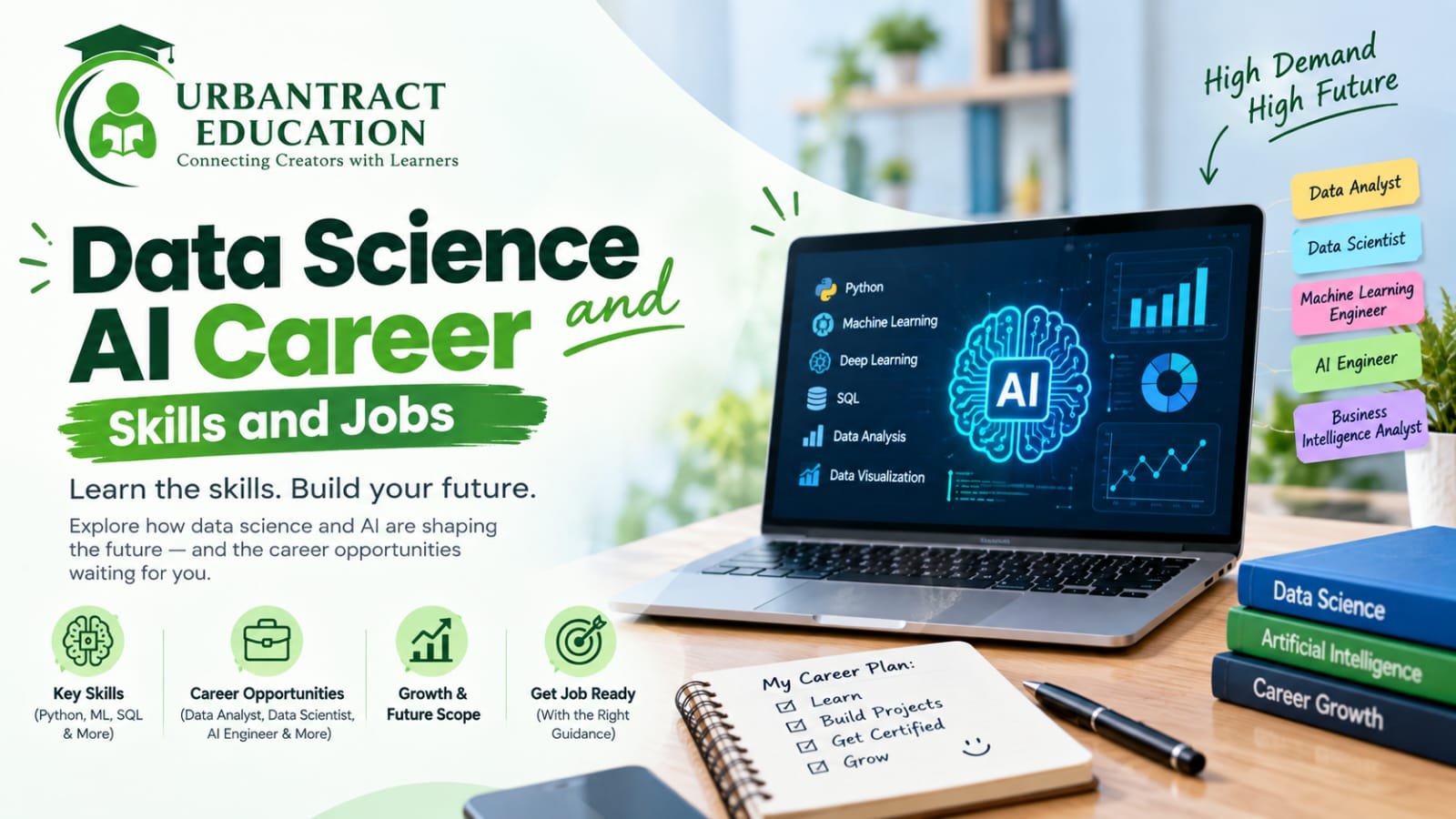
A Data Science and AI Career can open the door to several practical roles in today’s technology-driven job market. Businesses use data and AI to understand customers, improve operations, make decisions, and automate tasks. However, building a career in this field is not only about learning trendy tools. Employers also look for strong data basics, problem-solving skills, communication, and practical experience. This guide explains the essential skills, job opportunities, and learning approach that can help students and career switchers prepare for a job-ready future.
Thank you for reading this post, don't forget to subscribe!SEO CONTENT DETAILS
| Primary keyword | Data Science and AI Career |
| Secondary keywords | Data Science and AI skills, Data Science jobs, AI career opportunities, Data Analyst skills, Data Science and AI course in Agra |
| Long-tail / question keywords | What skills are needed for a career in Data Science and AI?; What jobs can I get after learning Data Science and AI? |
| SEO title (56 characters) | Data Science and AI Career: Skills and Job Opportunities |
| Meta description (143 characters) | Explore a Data Science and AI career, learn essential skills, discover job roles, and see how practical training can help you become job-ready. |
| Suggested URL | urbantract.co.in/data-science-ai-career-skills-jobs |
H1 — Data Science and AI Career: Skills You Need and Jobs You Can Get
Have you ever looked at the growing use of AI and data in businesses and wondered where you could fit into it? A Data Science and AI Career can lead to several practical roles, but getting started is not only about learning trendy tools. Employers also look for strong data basics, problem-solving ability, communication, and evidence that you can apply what you learn. That is why this guide focuses on the skills, job roles, and learning approach that can help a student or career switcher move from interest to job readiness.
What Skills Are Needed for a Data Science and AI Career
Data Science is mainly about turning raw data into useful information for decisions. It can involve collecting, cleaning, analysing, visualising and modelling data. AI adds techniques that allow systems to recognise patterns, make predictions, automate tasks or support decisions. In real workplaces, the two areas often overlap rather than existing as completely separate careers.
For someone starting out, the important point is simple: you do not need to master everything at once. A sensible path begins with data handling and analytical thinking, then moves into machine learning and AI applications as your foundation improves. Current career guidance also highlights Python, SQL, statistics, data wrangling, visualisation and practical project work as useful foundations for data-focused roles.
Indeed career guidance.
Why Consider a Data Science and AI Career?
Businesses in finance, healthcare, retail, technology, manufacturing, marketing and other sectors increasingly use data to understand customers, improve operations and make decisions. AI is also moving beyond research into practical business workflows. This creates opportunities for people who can connect technical skills with real business problems.
Page 1
The opportunity, however, should be viewed realistically. A course certificate alone does not make someone job-ready. You need to practise, build projects, explain your work clearly and keep learning as tools change. Recent career guidance from IIT Kharagpur similarly stresses practical skills, portfolio work and strong foundations rather than chasing job titles alone. IIT Kharagpur AI career guide.
If you are asking, “What skills are needed for a career in Data Science and AI?”, start with the fundamentals. The strongest learning plans build technical ability step by step instead of jumping directly into advanced AI topics.
| Skill | What you use it for | Why it matters |
| Python | Data handling, analysis and model development | A widely used language for data and AI work |
| SQL | Querying and working with databases | Helps you access and analyse real business data |
| Statistics | Understanding patterns, variation and relationships | Supports sound analysis and model evaluation |
| Data Visualisation | Dashboards, charts and clear reporting | Makes findings easier for others to understand |
| Machine Learning | Prediction, classification and pattern detection | Provides the foundation for many AI applications |
| AI Concepts | Automation, intelligent applications and AI workflows | Helps you apply AI responsibly to practical problems |
| Communication | Explaining findings and recommendations | Technical work must create value that teams can act on |
Build skills in the right order
A beginner can make the learning process easier by following a sequence: first understand spreadsheets and data basics, then move into SQL and Python, followed by statistics, visualisation and machine learning. Once these foundations are comfortable, AI concepts and projects become easier to understand. The official Python documentation is a useful reference when learning the language itself.
Python documentation.
Soft skills should not be left until the end. A good analyst or AI professional needs to ask the right question, explain what the data says, understand the business context and communicate limitations. For AI work, responsible thinking is also important because AI systems can create risks related to reliability, fairness, privacy and security. NIST’s AI Risk Management Framework is a useful reference for understanding trustworthy AI practices. NIST AI Risk Management Framework.
Career Opportunities in Data Science and AI
Instead of collecting a long list of certificates, focus on being able to demonstrate the following:
- Cleanand organise a messy
- Writebasic-to-intermediate SQL
- UsePython for analysis and simple
- Createa dashboard or clear visual
- Explaina model or insight in simple
- Buildand document practical projects that you can discuss in an
A Data Science and AI career does not lead to only one job title. Your role will depend on your skills, education, project experience and the type of work you enjoy. Some roles are more focused on analysis, while others involve machine learning, AI systems or business decision-making.
| Job role | Typical focus | Useful starting skills |
| Data Analyst | Reports, dashboards, trends and business insights | SQL, Excel, Python, visualisation |
| Junior Data Scientist | Analysis, modelling and predictive insights | Python, statistics, SQL, ML |
| Machine Learning Engineer | Building and deploying ML systems | Python, ML, APIs, software basics |
| AI / GenAI Developer | AI-enabled applications and workflows | Python, AI concepts, APIs, problem-solving |
| BI / Analytics Professional | Business reporting and decision support | SQL, dashboards, business understanding |
| AI Business / Product Role | Applying AI to business or product problems | AI awareness, communication, domain knowledge |
Choosing a Data Science and AI Career Path
If you are a beginner, Data Analyst or analytics-focused roles can be a practical starting point because they let you develop core skills such as SQL, data cleaning, visualisation and business reporting. With stronger programming, statistics and machine learning skills, you can move toward Data Scientist or Machine Learning roles. AI application roles can also become accessible as you learn how models and AI tools are integrated into real products.
This is not a fixed ladder. Your previous education and work experience can change the best route. For example, a commerce graduate with strong business understanding may fit well in analytics, while a programming-focused learner may prefer ML or AI development.
Industries Where these skills are used
| Industry | Examples of data/AI use |
| Banking & Finance | Risk analysis, fraud detection, customer analytics |
| Healthcare | Data analysis, operational insights, research support |
| Retail & E-commerce | Customer behaviour, recommendations, demand planning |
| Marketing | Campaign analytics, segmentation and forecasting |
| Manufacturing | Quality monitoring, forecasting and process optimisation |
| Technology | Product analytics, ML systems and AI applications |
The biggest mistake beginners make is trying to learn every tool at once. A better approach is to build one layer at a time and use projects to connect the concepts. The goal is not to know every library; it is to become confident enough to solve a problem and explain your approach.
| Stage | Focus | Practical outcome |
| 1. Foundation | Excel/data basics, logic and basic statistics | Understand datasets and simple analysis |
| 2. Data Tools | SQL, Python and data cleaning | Work with real datasets |
| 3. Visualisation | Charts, dashboards and reporting | Present useful insights clearly |
| 4. ML & AI | Machine learning and practical AI concepts | Build and evaluate simple models |
| 5. Projects | Real-world datasets and capstone work | Create portfolio evidence |
| 6. Career Prep | Resume, interview and portfolio guidance | Present skills confidently to employers |
Practical Learning for a Data Science and AI Career
When you are comparing training options, look beyond the course name. Ask whether the programme gives you opportunities to work with real datasets, complete projects, use relevant tools and receive feedback from trainers. Those experiences make it easier to move from knowing a concept to actually applying it.
UrbanTract Education’s Data Science + AI Course is designed around practical learning. According to the course page, the programme is intended for beginners, students, graduates and working professionals and includes real-world projects, a capstone project, expert mentorship and portfolio-focused learning. The listed tools include Excel, Power BI, AI, Matplotlib, NumPy, Python, Seaborn and MySQL.
The course page also lists a 3–4 month duration, offline classes five days a week, a certificate of completion and placement assistance. Placement assistance should be understood as support rather than a guarantee of employment; your results will still depend on your skills, projects, interview performance and the opportunities you apply for.
What Makes UrbanTract’s approach relevant?
For a learner who prefers guided, classroom-based practice, the programme combines several elements that are useful when building a job-ready profile:
- Industry-orientedlearning with practical
- Exposureto commonly used data analysis and AI-related
- Real-worlddatasets and a capstone project for portfolio
- Careerguidance, interview preparation, resume building and portfolio
- Abeginner-friendly entry point without requiring a technical background, according to the course
Not every learner needs the same route. A self-learner may prefer flexible online resources, while another student may learn faster with classroom guidance and a fixed structure. The important thing is to choose a method that helps you practise consistently and produce evidence of what you can do.
| Approach | Good for | Watch out for |
| Self-learning | Learners who enjoy independent study | Random tutorials can create gaps |
| Short certifications | Learning one focused tool or concept | A certificate alone is not a portfolio |
| Structured classroom course | Beginners who want a guided path and feedback | Check curriculum, projects and trainer support before enrolling |
| Project-based learning | Anyone preparing for practical interviews | Projects should be documented and genuinely understood |
Related UrbanTract learning resources
Before choosing a course, you can also compare related learning options and career guidance on UrbanTract. Read the Data Science vs AI career guide to understand how the two areas differ, or explore the Digital Marketing with AI Course if your interests are closer to marketing and AI. The Job-Ready Skills guide is another useful resource for comparing practical skill development options.
Frequently Asked Questions
1. What skills are needed for a career in Data Science and AI?
Start with Python, SQL, statistics, data cleaning, visualisation and problem-solving. Then add machine learning and practical AI skills as your foundation improves.
2. What jobs can I get after learning Data Science and AI?
Depending on your skill level, you can target roles such as Data Analyst, BI/Analytics professional, Junior Data Scientist, Machine Learning Engineer or AI-focused developer.
3. Is Data Science and AI suitable for beginners?
Yes, beginners can start with the fundamentals. The key is to follow a structured sequence and practise through projects rather than trying to learn advanced topics immediately.
4. Do I need a technical background to learn Data Science and AI?
A technical background can help, but it is not the only route. Beginners from different academic backgrounds can start with foundational data, programming and analytical skills.
5. Is Python important for Data Science and AI?
Yes. Python is widely used for data analysis, automation and machine learning. Learning the fundamentals gives beginners a useful base for later AI work.
6. Are projects important for getting a job?
Yes. Projects give you something concrete to discuss in interviews and can demonstrate how you approach real problems. Quality and understanding matter more than simply having many projects.
7. Does completing a course guarantee a job?
No. A course can provide structured learning and career support, but employment depends on skills, projects, interview performance, the role and the hiring market.
Conclusion: Build Skills, then build your career
A Data Science and AI Career can offer different directions, from data analysis and business intelligence to machine learning and AI applications. The most useful starting point is not to chase every new technology. Build a strong base in data, Python, SQL, statistics and visualisation, then add machine learning and AI through practical projects.
If you are looking for a structured way to learn these skills, UrbanTract Education’s Data Science + AI programme offers classroom learning, practical projects, real-world datasets, a capstone project and career-oriented support. Review the curriculum, understand what you will practise, and choose a learning path that fits your goals and current level.
Start your Data Science & AI journey with UrbanTract
Ready to turn your interest in data and AI into practical skills? Explore UrbanTract’s Data Science + AI Course and speak with the team about the curriculum, learning format and admission process.
Need guidance before enrolling? Contact UrbanTract Education for course guidance and understand whether the programme matches your career goals.
E-E-A-T & SOURCE NOTES
Content approach: Informational + transactional search intent; reviewed against current career guidance and UrbanTract course information.
External sources used for research
- Indeed— Learn About Data Science Careers — roles, responsibilities and
- IITKharagpur — AI Jobs & Career in India — AI roles, foundational skills and portfolio
- Naukri Campus— How to Start an AI Career in India — AI career paths and preparation
- PythonDocumentation — official Python learning
- NISTAI Risk Management Framework — trustworthy and responsible AI
UrbanTract sources
- UrbanTractData Science + AI Course — course format, tools, projects and
- UrbanTractBlogs — existing blog topics reviewed to avoid unnecessary
- UrbanTractData Science vs AI guide — existing related topic reviewed for